There’s a memory tucked in the back corners of my mind, forgotten about entirely until now. I’m a small child, three years old at the most, sitting on an old porch swing beside my grandmother as a soft breeze tousles my hair. Grandmother is squeezing canned cheez whiz in the shape of alphabetical letters on Ritz Crackers laid out on a napkin between us. Grandmother hands me a cracker with a pale, loopy “B” adorning the top. The porch is attached to my grandmother’s house; she raised two children here; she had a long but-not-long-enough-marriage develop and evolve within this same framework. A lifetime of major moments, conversations left unfinished, joy and even heartache must’ve been lingering in that house, etched into the ceilings and seeping down to the floorboards, I wonder if it still is. In this tiny memory, I know the house is up for sale; Grandmother will regret leaving this house, she says this to me at least three times, in three different conversations spaced years apart. She talks about it like a mecca, as if staying in that house could have saved her or this family. But this is where the memory ends, I do not know how long we stayed or how many crackers we ate.
Grandmother sold her house because she moves in with my mom three years after my grandfather dies. After his death Grandmother was alone in that house with multiple state lines separating her from the rest of her remaining family. South Carolina is not new to my grandmother; she was born in Graniteville but has called Montgomery home for at least thirty years leading up to her move into my mom’s house. My mom has three children, my two older brothers and me, and my grandmother wants to be more involved in our lives.
Although there is no personal recollection of this, I know my tiny memory took place somewhere throughout the visit only made to finalize the sale, I’m unsure if she had any remaining items to bring home. I don’t know how you decide which items are worthy of hanging onto when you’re packing up entire lifetimes, or worse, which items you decide to leave behind. Over the years Grandmother became somewhat of a hoarder, multiple warehouses filled with items no one needed or wanted. She had a propensity for holding on to broken shit that no one was going to fix anytime soon; looking back I wonder if this habit developed in an attempt to retroactively heal a Alabama shaped heartache. As if the wrong thing got left behind and the only way she knew to prevent it from happening again was to hang on to every single item for the rest of her life.
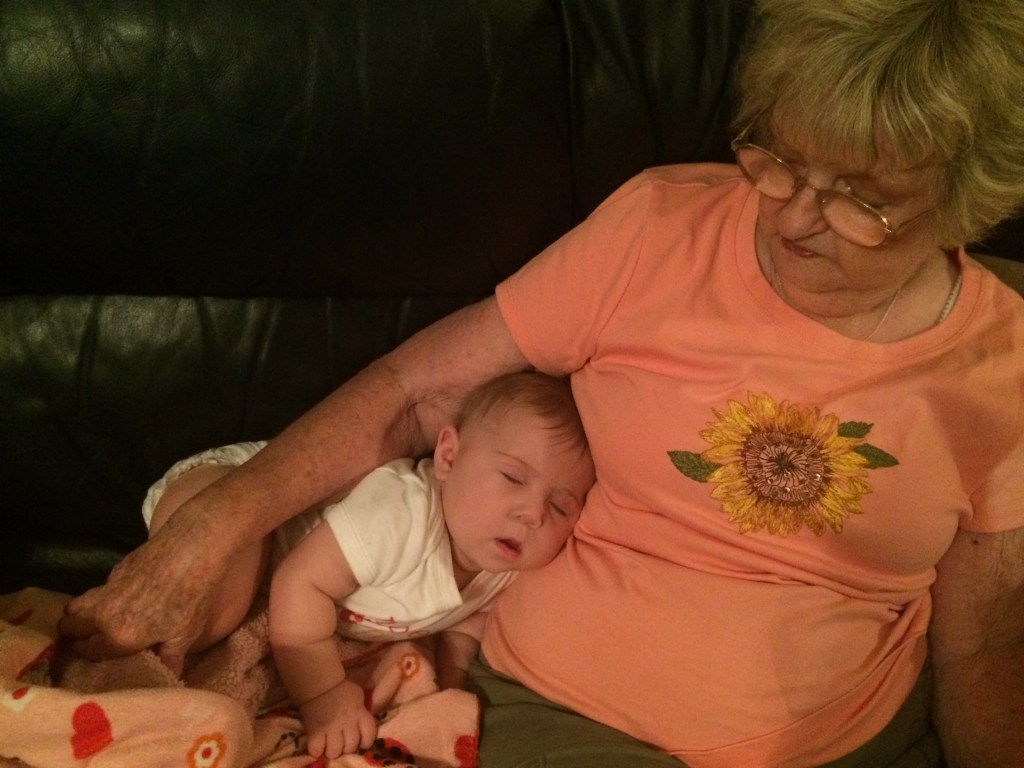
Being a grandparent was a role Grandmother didn’t take lightly. She loved it. There are pictures of me as an infant wearing christening gowns and bonnets (we are not catholic) and as I grew so did my collection of alligator clip bows in every size for every theme and every holiday, which Grandmother placed in my hair daily until the end of elementary school. Grandmother swore she didn’t choose favorites, but I know our relationship was different than the relationship she had with my brothers. Grandmother told me often that I helped save her, “of course I love the boys, they’re my everything” she’d say, “but when you were born and I moved here, well it gave me purpose” It’s only now as I write this that I can feel the crushing weight of those words. The pressure that I cracked under and the disappointment she surely felt by how everything turned out over time.
I spent a lot of time with my grandmother growing up, I even slept in her bed most nights until nearly middle school. Grandmother was often the first and last person I spoke to before going to sleep and waking up. Where Grandmother went, I went, and it stayed that way for a long time.
If I’m in a quiet room and I close my eyes hard enough, I can almost hear her voice whispering “get at my back, bri” as she’d always recite when the space in her bed between us had grown too large. She came to all my dance recitals, all my softball games, she walked me to the bus stop every morning in elementary school. She took me to my first concert, we saw Toby Keith around my eighth birthday with concert tickets I now realize she couldn’t afford but purchased anyway. In high school, when my childhood best friend and I decided on a carpool-like routine, my grandmother drove us to school every morning (and my friend’s dad drove us home in the afternoons). Grandmother never complained about doing these things and usually appeared happy to be part of the ride.
In the ninth grade, Grandmother planted her feet firmly in front of a Rue 21 check out counter while she called my mom at home to ask if I was allowed to buy and wear thong underwear. In that moment, standing in front of the retail cashier that I never saw again, I knew I would never recover from the embarrassment. When my mom approved of my undergarment purchases, Grandmother remained disgruntled. After realizing this was a fight she wasn’t going to win, said stepped aside only after saying “one day you’ll get why those aren’t right.” On the drive home she sighed and asked me again “why would you want to buy that?” This was a sore subject in our house for a week. As if chauffeuring me to purchase a single pair of cotton thong underwear was a code word and I’d purchased an extra-large dildo or a crack pipe. The gateway panties from thong straight to prostitution, there is no going back.
At this point I’m ready to admit Grandmother was correct: thongs are not practical and it’s been at least eight years since I stopped pretending like they’re comfortable. In real life, as I write this, it’s 9:42pm on February 16, 2025 and my grandmother has been dead for almost two weeks.
It’s indulgent to tell the story this way, in present tense, as if I can stop it. As if I’m retelling the story of a burglary and there’s an ankle to be grabbed to stop the burglar from escaping. There is no way for me to stop what’s already happened and there’s no ankle to be grabbed. But this is the only way I know how to explain her death.
I don’t know when my grandmother stopped being known as Dolores Hydrick and instead known only as Grandmother, but it’s what everyone called her, not just her grandchildren. Not Grandma, because that’s old, but Grandmother. Grandmother was a tiny woman, she claimed 5’1” but at my height of 5’8” I know I had at least ten inches over her. Even tinier than her height were her shoes, her heels sliding out the backs of women’s size 5s. Her crooked fingers always had painted nails, usually a shade of pink. And fashioned on her face were glasses 4x the size of her eyes. Her feet were always ice cold but her presence was always warm. In the mornings she loved to drink coffee as she sat outside, as I write this I’m slapped with the image of her stuck inside my mother’s home throughout the final years of her life. We went on trips to Tennessee multiple times per year, she went grocery shopping independently, and she visited her sister a few miles down the road on a near daily basis. Grandmother loved to drive, and she loved her car.
In 2012, Grandmother had a scheduled procedure to place stents in a coronary artery that’d become narrowed. When this run of the mill procedure suddenly turned into triple bypass open heart surgery, plans changed and while she successfully completed her post-op outpatient cardiac rehab, Grandmother was never quite the same. She tired easily, and that made sense, but then her balance changed, her hearing declined. Less than three years later she fell, breaking her femur in two.
When I was seven, I walked outside to find Grandmother lying in the grass in the front yard. She’d mistakenly skipped a stair when stepping off a ladder then tried to brace her fall, breaking her wrist. I’d gone outside to tell Grandmother my pet bird had finally stepped on my finger! I’m embarrassed now, writing this down. I didn’t ask Grandmother if she was ok as she was laid out for everyone to see. I don’t remember who told my mom, I don’t think it was me, but if it was it was only after talking about my bird.
When my grandmother came to the hospital after her femur broke, I still worked in the Emergency Department she was brought to. A part of me still that same seven-year-old girl, I didn’t immediately greet her to see how she was doing. I preemptively apologized to my coworkers about my mom who would surely arrive at the same time. I attempted to look in from the distance or gather details from those involved. I could have walked in the exam room, and I did eventually but only briefly.
After that surgery, the Grandmother I knew and was practically raised by never fully came back. The falls became more frequent, each one worse than the last. Around the same time, she was diagnosed with intramedullary thyroid cancer which isn’t responsive to chemo or radiation, so the only option was a total thyroidectomy. The cancer was unable to be fully excised without putting my grandmother in a trach collar. She didn’t want that, understandably. Instead, she was left with damaged vocal cords and a cancer still circulating. Her voice turned to a coarse whisper that exhausted her to use. This never got better and my once chatty grandmother turned quiet. My mom did most of the talking for her, frustrated that Grandmother couldn’t speak or hear well. My grandmother was now dependent on other people entirely.
There were no more car trips, no more independent grocery shopping, no more day dates with peers or family. As if my childhood home was an empty shell inside of those walls my grandmother morphed into a hermit. My once modest and well-kempt grandmother became dull and unheard; her hair no longer curled; her nails no longer painted. Text messages were hard for her to see, phone calls were difficult for her to participate in. I want you to know, whoever you are, that many of us reached out and tried to get Grandmother moved elsewhere or asked if she was okay but she remained loyal to her home and to my mom. I cannot say that earnestly because I could have tried harder. If I had, I might be able to remember when I last heard her true voice, her real laugh, when I looked her in the eye. But I don’t.
Two days before she died, I went home. Grandmother’s body lying obtunded in the middle of a hospital bed parked in the living room. Laced white curtains were hanging on the window beside her. A striped shirt swallows her body whole.
This is the second time I’ve seen her in almost four years.
I open the front door and as soon as my body crosses the threshold, it feels like I’ve walked thru a time portal back to the worst years of my life. I’m six inches taller than my mom and my brothers stand at eye level with me. I’ve never been a petite person but, in this moment, my thirty-year-old body feels three feet tall. My heart is pounding, I fix my focus straight ahead without allowing myself to look around. My hands begin sweating just as my mom comes into view. She cocks her head to the side and smiles with only the corners of her mouth as she says my name in a voice two octaves higher than her normal.
My mother, Pam, is difficult to explain but even more difficult to be around. Pam is on her fourth marriage; she tells people she’s *only* on her third however public marriage licenses dispute this. That’s basically the theme of every interaction with Pam; one thing is said but the truth lies somewhere else.
Pam is uncomfortable with silence, she talks incessantly and about nothing, almost exclusively about her hypochondria and hypothyroidism. Conversations are always one sided after Pam forcefully takes the lead. She switches between topics so rapidly no one can follow along. At times I try to convince myself Pam isn’t a liar or delusional or mentally ill or a combo of all three, instead I tell myself she’s a vivid storyteller. This is the only way I can get through it. Pam rattles off tales of this young mother caring for her three young children alone. She tells these stories so convincingly I almost forget she’s talking about herself. Pam talks about taking us to school, attending every extracurricular, playing with us on the floor. My mom has been unemployed since 2002, I can’t think of a single time she played with me. Instead, I remember going into her bedroom more times than I can count, grabbing her shoulders and shaking them, yelling her name to wake her up. Pam says she’s a hard sleeper and somehow that’s the only detail she focuses on if I correct her. She has insomnia, she says. I don’t know how miserable It is, she says.
My brain struggles to process both Pam and Grandmother being in front of me. I consider Grandmother to be one of, if not the only adult that truly cared about me as a child. My feelings about Pam oscillate day by day however I do mean it when I say I do not and cannot hate her.
I am angry with her but more importantly I am deeply hurt by her. Pam’s version of events has consumed so much of much life I struggle to trust my own memory. I’ve spent years in therapy trying to differentiate what I remember from what I’ve been told I should remember. It hurts less to look past Pam for who she is and instead reclaim her actions as outward displays of rich imagination. Yet no matter how many therapy sessions I go to or how much proof I have in front of me, Pam’s storytelling is so tightly intertwined with my memory I still struggle to trust which version is the truth.
Maybe my memory is not good? Maybe Pam is right, maybe I did make that up? The constant need to factcheck my own experiences, always phoning a friend to ask if they remembered this too; texts to my brother attempting to piece together a timeframe only to find out somehow his memory is just as fragmented as mine if not more…the labor of doing this became a full-time job I wanted to quit but couldn’t.
Pam plays dirty and slings insults without a second thought. An apology will never come even after the dust inevitably settles. Text messages still lie dormant in my inbox documenting her tantrums. There are tens of dozens of screenshots documenting her verbal abuse; all caps calling me a whore, I’m nothing but a drunk, paragraphs only half making sense as she threatens taking me to court (the reason why shifting with the moon phases). For every threat, every ring doorbell recording of her standing on my patio unannounced and uninvited begging to come in as she beats on my front door, and every horrible insult she throws at me by text—woven between them are short sentences “Happy birthday, I love you” “Tell Stella Pearl I love and miss her.” “Merry Christmas” the whiplash from each sentiment gives me headache even now as I retell them.
In September 2021 Pam and I argue like we do at least one day every week. I don’t remember why and I don’t remember how long it lasts but something flips a switch in my brain and I finally admit how exhausted I am. How depressed this makes me. I can’t do it. I can’t keep fighting with my mother every day, I can’t be called a whore and a drunk and a disappointment every Tuesday then pretend we’re ok by Thursday.
I tell my mom I’m done. I exhaust every word I know as if it might force her to see how badly she hurts me. Paragraphs written despite knowing deep down she will not read them, and she either can’t see or doesn’t care that she hurts me. Still, I do not cry. I do not cry because I have done that before and it did not make anything softer. For my own well-being I must acknowledge that maybe in Pam’s world this really is the best my mother can do.
In our final moment together Grandmother is resting with her eyes closed. She’s groaning quietly. She has always been small but now she weighs less than 70 pounds. I see every bone in her arms, her jaw is jutting out even at rest, unable to hold in the dentures she swears no one knows about and we certainly don’t talk about. Every rib can be counted through her shirt.
Pam tells her I’m home, I’m here. “Mom? Bri is here. It’s Brianna. She’s right here.” A chair is pushed under my legs forcing me to sit. Suddenly I’m center stage and the spotlight is on me. Grandmother turns her head toward me and I close my eyes. I cannot bear to see her this way. Grandmother tries to say something, but I don’t know what it is, it’s a grumble at best. I open my eyes at the exact moment she opens hers and looking back at me is someone I don’t know anymore. I could have held her hand, touched her shoulder, done anything actually but I don’t because I am a coward and I am scared.
I immediately stand up. I move across the room. My face feels hot. I leave an hour later and do not go back and do not see her again before she finally dies. I cannot remember if I told her I love her. Why wouldn’t I have said that? Surely I told her I love her. I recount every step and every breath made from the second I entered the house up until I buckle my seatbelt to drive home, yet everything fades to black once I get to the moment I’m standing over here to say goodbye. I’m squeezing my eyes shut trying to will my temporal lobe into action but instead flashbacks from childhood rush to the surface. The porch swing, the eggs made sunny side up, the brand of her fucking television set and her stupid floral comforter. All these useless snapshots flipping thru my head like some sort of haunted rolodex but I still can’t remember the quick exchange from less than two weeks ago.
We spent decades together inside of that house. I can’t begin to count all the events she tirelessly attended, the moments she made me feel seen and heard yet despite those things I was not there when she died. I was not beside her as she struggled to take her last breath, I didn’t make her another cup of coffee or scoot up against her back like I know she would have done if roles were reversed.
I love my grandmother, and I know she loved me too, I’d like to think she is still somewhere now, loving me from atoms away. But before she became a grandmother, Grandmother was only a mother. The bond between grandmother and my own mom, Pam, is too tangled to possibly unweave. This fact is ultimately solidified when Grandmother dies on Pam’s sixty-third birthday. When I was a child, Grandmother likened herself as the mediator between mine and Pam’s many arguments. Overtime this unbiased mediator became my abuser’s biggest enabler. Many times, Grandmother would take me aside and tell me I need to apologize to Pam; “you only get one mother, and one day she will be gone” she repeated often, each time more feeling more threatening than the last. Most of the memories I have of Grandmother have been overshadowed by Pam in one way or another and now in the ultimate mind-fuck, even Grandmother’s death, her last memory if you will, is forever linked to Pam. On one hand my grandmother dying means I’ve lost the person I believe cared about me most; but on the other hand, my grandmother dying means the only person who excused and justified and facilitated my mother’s abuse is finally gone. Still, I cannot mourn the death of my grandmother without being immediately reminded about the birth of my mother.
For the remainder of my visit at home, I sit on the same navy blue loveseat that’s been in that living room for over two decades. My brother Shawn, the oldest of the three of us, shifts uncomfortably in his seat to my left. Our brother Joshua, the middle child, is across from us on the matching navyblue couch. Joshua is playing on his phone but remains mostly responsive to the conversation around him. We both attempt to make small talk, we talk about our daughters, my youngest and Joshua’s only were born ten days apart. We talk about work. I’m a nurse at a local inpatient psychiatric facility, the same facility Joshua previously worked at alongside his now-wife, Deasia. Joshua and Deasia have not worked at this facility in over three years but it’s the only thing I know to connect with him. Our conversations always follow the same script: he asks if Magnolia, my two-year-old daughter, is doing X and I say no she’s doing Y. I ask If Wynter, my two-year-old niece, likes Y and he says she prefers Z. We’ve now exhausted the list of acceptable talking points, I don’t know what to say, I rely on Shawn to fill the relationship-shaped-space between me and Joshua.
As we all talk, or don’t talk, there is only one recent photo on the walls of my childhood home, a canvas print of Joshua and Deasia from their wedding in 2021. Shawn and I have also had beautiful weddings, we’ve also had beautiful wedding photos taken but they are nowhere to be found on these walls, likely nowhere to be found in this house. Pam doesn’t ask about my relationships or about Shawn’s wife, Tori. When Shawn and I both began distancing ourselves from Pam, myself more aggressively and dramatically, Pam blamed our partners. I’m not sure what the logic to that is, to be honest, my only guess is that Pam’s mind couldn’t fathom her own flesh and blood disliking her actions so blaming our partners was the only way her mind could process it at all.
Shawn points out the canvas on the wall, “I guess we know who the favorite is” and we both chuckle while Joshua plays aloof. It’s a joke but it’s not. Joshua is Pam’s favorite child. He still visits her occasionally, he answers the phone, he doesn’t gossip, he stays in his own little world. Joshua has always been like this; he’s smart but sometimes unmotivated, he’s quiet and has a dry sense of humor, he has a routine, and he sticks to it. Wedged between me and Shawn, Joshua could be easily overlooked if you’re not mindful. As a teenager I was jealous of my brothers, the two of them made good grades in school, participated in extracurriculars, Shawn specifically made everything look easy while Joshua was able to keep his head down without bringing forward any unwanted attention. This remained a point of contention particularly through my teenage years. I have a partial memory of an argument with Pam, I don’t know what triggered it but I vividly recall yelling “It’s obvious you love Joshua more! That he’s the favorite!” before slamming my bedroom door. Joshua was soon on the other side knocking, I opened the door to be greeted by his voice, soft but stern, asking “Brianna, c’mon, do you really think that’s true?” the memory fades to black, I do not remember the resolution, if one even existed, and it doesn’t matter anyway because I’m not sure Joshua remembers the interaction at all.
Joshua is six years older than me and two and a half years younger than Shawn. The nearly nine-year age gap between Shawn and me meant he was halfway out the door by the time my working memory developed. Joshua and I spent more time together as kids. When I was very small, he would entertain me by playing with my barbie dream house if I referred to it as a Scooby Doo Mansion instead. As we got older, the interactions became less personal and less childish. Sometimes I’d ask to listen to his ipod because I didn’t have one, and he’d let me scroll his playlist while he played video games. Joshua and I have never had a fall out, but we’ve also never had a moment of true connection. While we’re together, we get along fine, but if we’re not together the two of us would likely never speak again if Deasia didn’t middleman our interactions via event e-vites.
As I look at Joshua I’m curious if the palpable disconnect between the two of us is coincidental or just another thing Pam worked hard to orchestrate. The reality is that Joshua is not an enemy, and my hope is that in his story neither am I, but after an entire lifetime of our mother’s comparisons perhaps this is the lasting impact. If I say too much too quickly, I worry Joshua will think I’m too much like Pam, out of touch and theatrical at the expense of those around us. As Joshua sits quietly, eyes fixed on the phone in his hands, I wonder if his iPhone is playing a part in a modern day Pavlov’s experiment. Maybe this is what he’s been trained to do to escape the storytelling that goes on around us.
Once, someone mentioned the stark difference in our personalities when Pam is around vs when she isn’t. Like clockwork the three of us shrink down to tiny shells, making room for Pam’s persona. We all take a seat as Pam’s voice begins filling the room. The slow, southern dialect acting as our conditioning bell: Joshua pulls out his phone to watch a game, Shawn’s eyes glaze over as he goes quiet, my jaw is clenched so tight I’m scared a molar will shatter from the force. We’re all in the same room except we’re not. We retreat farther inside ourselves to make more space for our mother. Grandmother is in the bed behind Pam, settling after the liquid morphine finally kicks in. Our seating arrangement is so jammed tight our hands would overlap if we outstretched our arms at the same time. I look up for a split second to look at the people in front of me, my family, so close we could touch. Yet despite our proximity the five of us couldn’t be any farther apart if we tried.
Grandmother died around 9am on February 3, 2025. She was born on January 4, 1936. She was preceded in death by two of her sisters, one brother and her husband; she was a widow for thirty-four years but talked about my grandfather often. Grandmother has two children, four grandchildren, five great-grandchildren, one sister, and multiple nieces and nephews that are still here and all mourning her departure.
The truth is that I don’t know how to process this; the permanency of death is still shocking no matter the circumstances or the forewarning. Once a day, at least, I’m reminded she’s really gone, and each time it feels like the wind’s been knocked out of me. The shame of feeling sad when I was responsible for our estrangement is something I’m unable to articulate.
I want to kick and scream and cry. I’d give anything for this awful emptiness to go away. But more than anything I’m not ready to say goodbye. So, for now I’ll close my eyes and replay the tiny memory on the porch swing. The mornings I sat beside her as she sipped her cup of coffee, so vivid I can still smell it. The sound of her makeup bag rattling in our upstairs bathroom, signaling she’s up and getting ready for the day. Flipping through each one as if this loss is a book I’ll be allowed to someday return to some centralized sadness library.
But that’s the thing about grief. You can’t ignore it forever. I can’t ignore this forever. You can push it around your plate. You can project it somewhere else. But you can’t give it away.
 Wanna be blogger
Leave a comment